
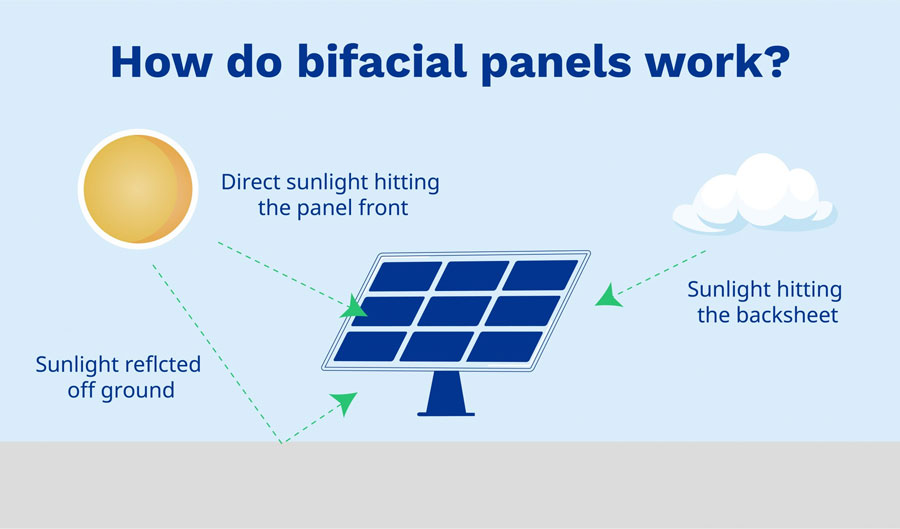
Unlike monofacial solar panels, bifacial solar panels are capable of receiving energy from the front and back surfaces of the solar panel. The solar cell in this Bi Facial solar panel is designed to receive sunlight from the back surface and convert it into electrical energy, in addition to receiving sunlight from the front surface and converting it into electrical energy. Typically, bifacial solar panels have a transparent back sheet and can also receive sunlight from the back surface.
You may be wondering how a panel that is tilted at an angle of 30 to 40 degrees to the ground can receive sunlight from the back surface. However, it should be noted that in an environment with a reflective surface of sunlight such as supporting isogamic surfaces, rocky, sandy and snowy surfaces, sunlight is strongly reflected and the return of light can increase the power of the solar panel by up to 30 percent.
Bifacial cells normally perform the same as the monofacial cells commonly found on the market, but the maximum output power of a monofacial cell is equal to the power listed in the solar panel catalog, but a bifacial cell can produce 5 to 30 percent more power.